
Why Scratch is the Secret Weapon for Math and Logic
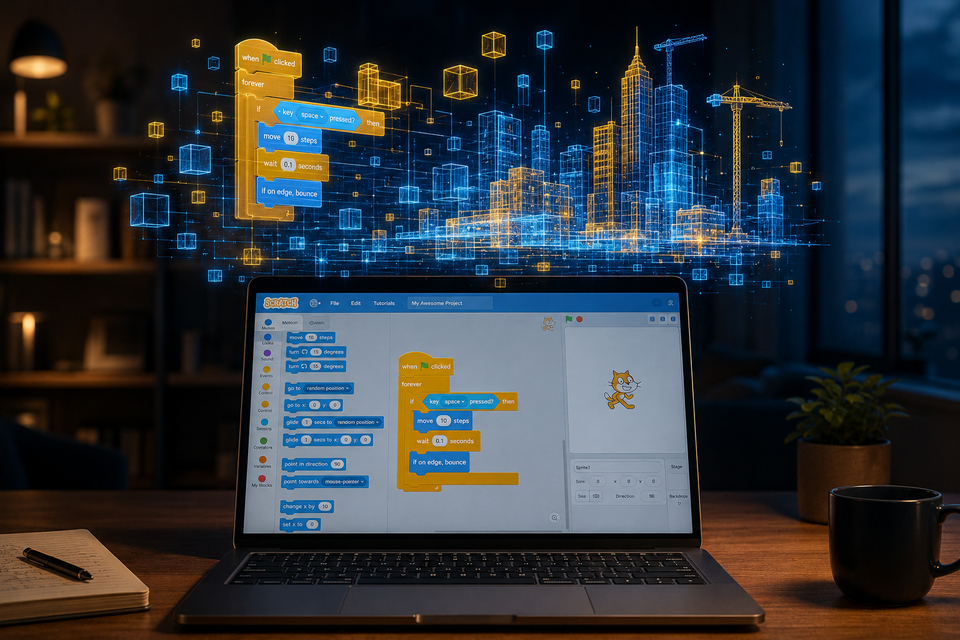
In the modern world, "digital literacy" is often mistaken for the ability to use an iPad or play a video game. But as we look toward 2026 and beyond, the real literacy isn't about using technology—it’s about understanding the Logic that governs it.
For parents, Scratch (developed by MIT) is the perfect bridge. It’s not just a "coding for kids" app; it’s a sophisticated laboratory for mathematical and logical reasoning.
1. The "Invisible" Mathematics of the Stage
When a student moves a character (a "Sprite") in Scratch, they aren't just dragging an image. They are unknowingly mastering the Cartesian Coordinate System.
- Spatial Awareness: To move a character to the top right, a student must understand $x > 0$ and $y > 0$. This turns abstract classroom math into a functional, visual tool.
- Variables in Action: When a student creates a "Score" or a "Health Bar," they are using Algebraic Variables. Instead of solving for $x$ on a worksheet, they are controlling $x$ to determine the outcome of their game.
- Geometry & Degrees: Every turn in Scratch requires an understanding of angles. Making a square requires $90^\circ$ turns; making a circle requires a "Repeat 360" loop. This is geometry in its most engaging form.
2. Building the "Architect’s Mindset" (Logic)
Programming in Scratch is essentially an exercise in Computational Thinking. It teaches children how to break down a chaotic idea into a structured blueprint.
- Conditional Logic (The "If-Then" Rule): This is the foundation of all decision-making. "If the character touches the lava, then the game ends." This trains the brain to predict outcomes and understand cause-and-effect.
- Looping & Efficiency: Instead of writing the same command ten times, students learn to use Loops. This teaches them to look for patterns and optimize their work—a skill that translates directly to efficient study habits and problem-solving.
- The Art of Debugging: In coding, a mistake is not a failure; it’s a Bug. Scratch teaches children to treat errors with curiosity rather than frustration. They learn to trace back their steps, find the "break" in the logic, and fix it. This resilience is the hallmark of a successful student.
3. Why Start with Scratch Instead of "Real" Code?
As a Senior Developer with 14+ years in the industry, I often see parents rushing kids into Python or Java. But starting with text-based code is like trying to write a novel before you can build a sentence.
Scratch removes the "Syntax Barrier" (the commas and brackets) and lets the child focus entirely on the Architecture of Logic. Once they understand how to structure a sequence, the transition to professional languages like Python becomes effortless.
Reflection for Parents
Is your child spending their screen time as a Consumer (watching YouTube/TikTok) or as an Architect?
By spending just an hour a week in the world of Scratch, your child is building the mental muscles for 21st-century success. They aren't just learning to code; they are learning how to think.
Member discussion