
Why 'Active Creation' is a Cognitive Catalyst
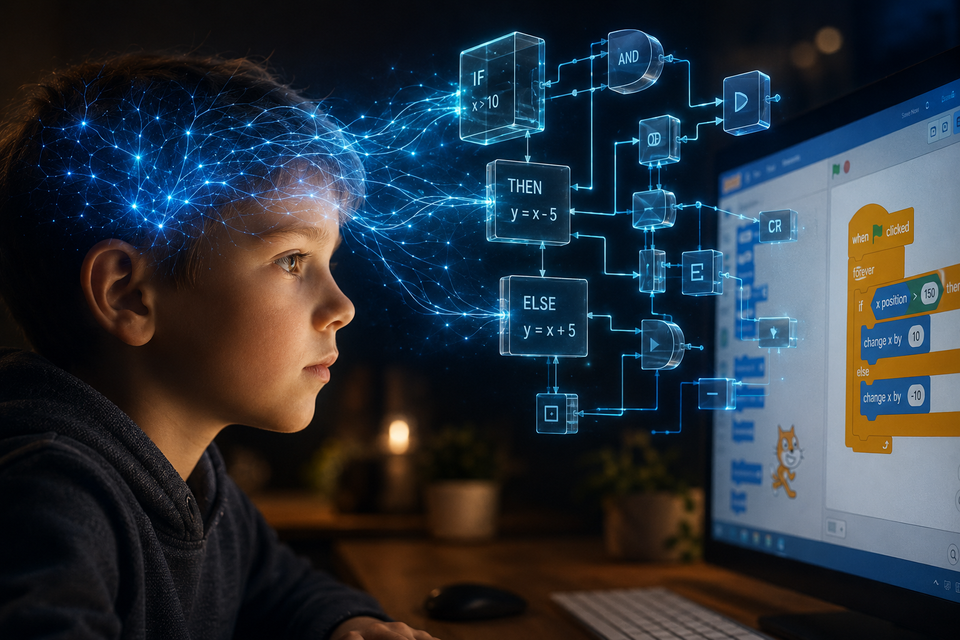
As a Senior Developer for 14+ years, I’ve spent my career staring at screens. But there is a fundamental neurological difference between the time I spend "consuming" a technical document and the time I spend "architecting" a system.
For our children, the current "Screen Time War" is being fought on the wrong front. It isn't about the quantity of hours; it’s about the cognitive load and the neurological reward system being activated.
1. The Dopamine Trap vs. The Dopamine of Mastery
Most digital products (YouTube, TikTok, mobile games) are engineered for Passive Consumption. They utilize a "Variable Reward Schedule"—essentially a digital slot machine—that provides high-frequency, low-effort dopamine hits. This leads to "Digital Fatigue" and reduced attention spans.
In contrast, coding in Scratch triggers the Dopamine of Mastery. * When a child spends 10 minutes trying to get a character to jump over an obstacle and finally succeeds, the brain releases dopamine as a reward for effort-based problem-solving. * This strengthens the "delayed gratification" pathways that are essential for high-level academic success.
2. Building "Executive Function" (The Brain’s CEO)
In pediatric neuropsychology, Executive Function (EF) is the set of mental skills that include working memory, flexible thinking, and self-control. Recent studies have shown that just one month of structured coding can improve a child's planning and inhibition skills more effectively than months of standard classroom activity.
In our 10-Module Architect Journey, we explicitly target these EFs:
- Decomposition (Planning): Breaking a "Big Idea" (making a game) into "Micro-Tasks" (movement, scoring, gravity). This is the same skill used to write a 20-page thesis or manage a corporate project.
- Response Inhibition: In coding, if you rush, the program breaks. Students learn to "inhibit" the urge to click randomly and instead think-then-act.
- Cognitive Flexibility: When a "Bug" appears, the child must pivot their strategy. This builds a "Growth Mindset" where errors are viewed as data points, not failures.
3. From "Digital Literacy" to "Digital Fluency"
At many International Schools or any elite institution, "Literacy" (knowing how to use Word or Google) is the bare minimum. We should be aiming for Digital Fluency.
- Literacy is knowing how to read the instructions on a tool.
- Fluency is knowing how to use that tool to express an original, complex idea.
By the time a student reaches Module 7: The World Builder’s Journey, they aren't just "coding"—they are using technology as a brush to paint their logic. They are no longer "users" of the digital world; they are its Architects.
My Verdict
If your child is "tired" after screen time, they were likely consuming. If they are "energized" and want to show you what they built, they were creating.
One of these habits prepares them for a career in the "Attention Economy." The other prepares them to lead it.
Member discussion