
The Roadmap: A Parent’s Guide to Navigating Tech Education

The digital landscape is noisy. Walk into any app store, and you’ll find thousands of "Learn to Code" apps promising to make your child a tech prodigy in ten minutes a day.
But as a developer with 14 years of experience, I’ve seen a pattern: Parents are overwhelmed. They want to give their children an edge, but they don't know if they are buying education or just screen time.
The truth is, true technical fluency is not a race to learn the newest programming language. It is a developmental path. It requires sequential building blocks.
If you want your child to thrive in a digital future, you need to stop looking at "classes" and start looking at the Tech Mastery Roadmap.
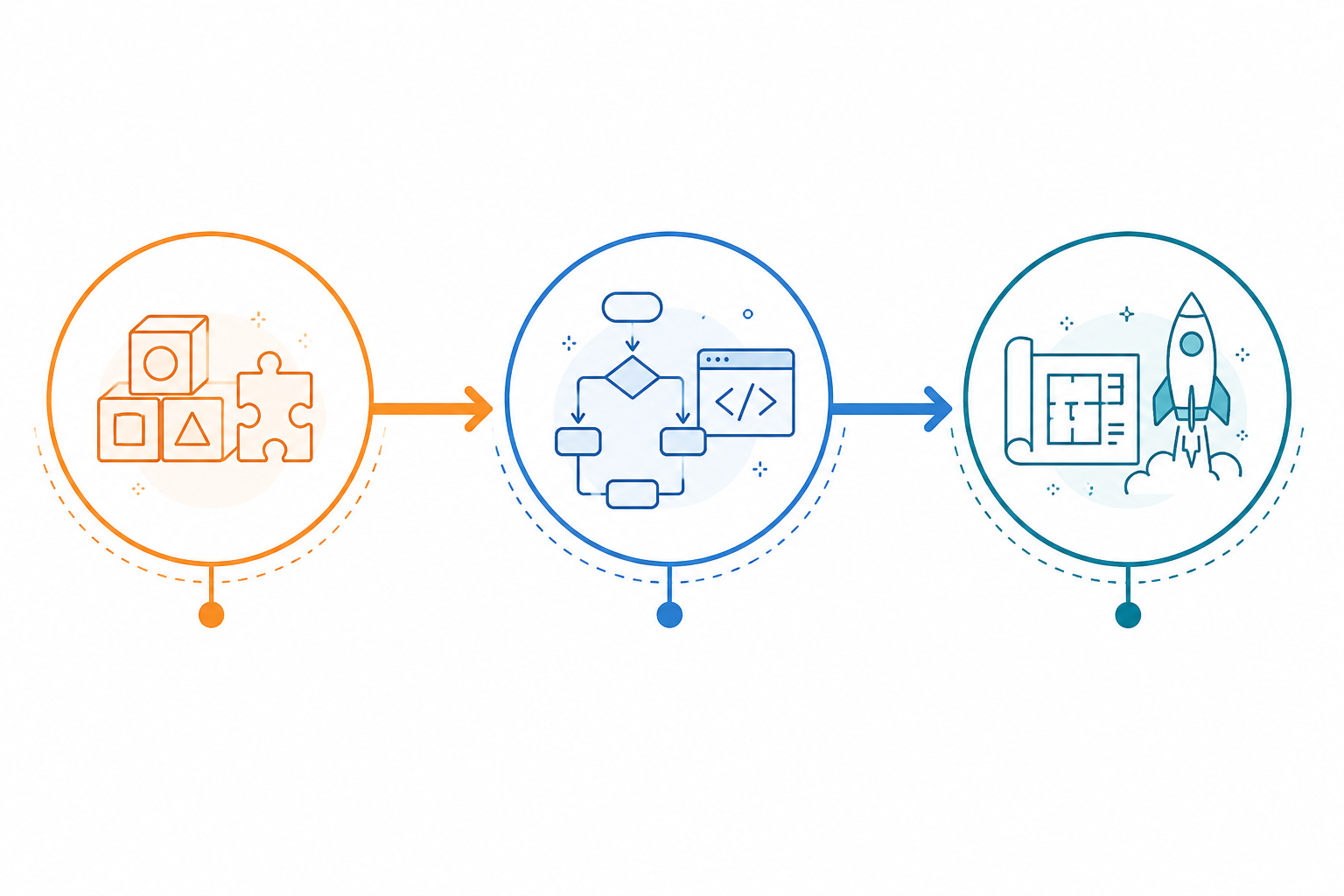
Phase 1: Logic Fundamentals
Goal: Cognitive Readiness
At this age, the goal is not "coding"—it is computational thinking. We are building the mental software required for later programming.
If a child skips this stage, they struggle with syntax later because they haven't learned to structure their thoughts. We aren't teaching them to memorize commands; we are teaching them to plan.
- Key Focus: Sequencing, Pattern Recognition, and Cause-and-Effect.
- The "Litmus Test": Can your child explain a sequence of steps to solve a simple paper puzzle without a screen?
- Success Indicator: They move from "guessing" to "planning" before they start a task.
Phase 2: Structural Programming
Goal: Systematic Building
Once the logic is established, we introduce the machine. This is where we bridge the gap between "thinking" and "doing." We move away from drag-and-drop mimicry toward building systems that work and—more importantly—systems that break.
In this phase, we embrace the "Bug." We teach children that an error is not a failure; it is simply a data point that reveals where their logic failed.
- Key Focus: Conditional Logic (If/Then), Variables, Debugging, and Algorithmic Thinking.
- The "Litmus Test": Can your child isolate the specific piece of logic that is causing their project to fail?
- Success Indicator: They stop asking "Why isn't this working?" and start asking "Which part of my logic is incorrect?"
Phase 3: Real-World Application
Goal: Autonomy & Creation
The training wheels come off. In this phase, the child stops following tutorials and starts defining problems. They are now using technology as a tool to execute their own unique ideas.
- Key Focus: System Architecture, Project Management, and Intentional Creation.
- The "Litmus Test": Can they conceive of an idea—a simple app, a data-driven tool, a game—and execute the steps to build it without external guidance?
- Success Indicator: The child becomes a creator rather than a consumer of technology.
Where does your child start?
The biggest mistake parents make is starting at the wrong phase. If you put a child who hasn't mastered Phase 1 into a Phase 2 environment, they will get frustrated, lose interest, and decide "coding isn't for them."
It’s not that they aren't smart enough; it's that they are missing the foundation.
Not sure where your child falls on this roadmap?
I’ve developed a 15-Minute Logic Audit. It’s a screen-free, paper-based diagnostic tool designed to help you identify exactly which cognitive stage your child is in.
Stop guessing where they stand and get the clarity you need to guide their development.
 The Dev Learnings Team
About Author
I am a software industry veteran with 14 years of experience building complex systems. I believe that before a child learns to code, they must learn to think. My mission is to help parents provide the logical foundation their kids need to succeed.
Member discussion